More support for young farmers, not mega mansions taking farmland out of production
 Historical contect from 2015 to 2022.
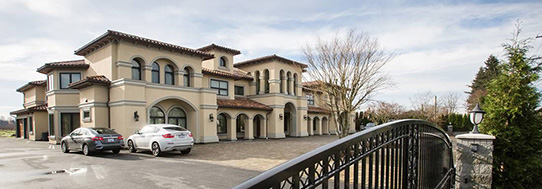
Mega mansions the size of hotels are paving over valuable Richmond farmland.
Farmland Being Used for Mega Mansions
Wealthy investors have been buying up prime Richmond farmland in order to build huge mansions and estates. Historically, there have been few limits on the size of such mansions with the result that the price of small farms has tripled over the past few years. This huge windfall profit has encouraged many Richmond farmers to sell their farmland to non-farmers which usually takes it out of production. There are tax breaks for even modest farming activities, but most new farmland owners are not interested in farming or leasing out farmland to farmers.
Understandably, many Richmond farmers are resisting any bylaw that would set a much lower limit on farmland house size. They control the advice provided to Richmond City Council by the Agriculture Advisory Committee. City Council enacted a bylaw in April 2017 to limit house size to 10,780 sq. ft. which is still a sizeable mansion. It has done nothing to slow the sale of farmland.
Richmond farmers wear two very different hats as both farmers and real estate investors. Allowing huge mansions on farmland has nothing to do with farming and everything to do with making money on real estate. Richmond city councillors have confused the two and think they're supporting farming by allowing mega mansions. There have already been over 60 development permit applications for farmland mansions over 9,000 sq. ft.
Farm Home Plate and Septic Field
The home plate is the amount of farmland taken up by the house, terraces, outbuildings such as garages, driveways, swimming pools and tennis courts. Since most farms are not connected to the community sewer system, they require a septic field, the size of which is porportional to the size of the house. The size of the home plate and septic field determine how much farmland is covered up by fill and no longer farmable. At present, the home plate on large farms can be 21,560 sq. ft., on smaller farms 10,780 sq. ft., and the septic field outside the home plate is additional. Some examples here illustrate how mansion building has destroyed farmland.
Urgently Required Short Term Action
Richmond City Council has refused to take further action so it is up to the BC Government to institue an immediate moratorium on building permits for houses larger than 5,400 sq. ft. until legislation can be introduced to:
- Limit farm home plate to 10,780 sq. ft. for all farms.
- Require the septic field to be on the home plate.
- Reduce the farm house size limit to 5,400 sq. ft.
Suggestion for Permit to Purchase Farmland
The BC Government could legislate new rules for the sale of ALR farmland:
- Require a permit from the ALC for the transfer of beneficial ownership of farmland.
- Permit approval requires new owner to provide either an approved business plan for a productive farming activity or an assignment to the ALC of leasing rights for the farmland.
- If a business plan is not implemented within two years, leasing rights are assigned to the ALC.
- ALC leases the farmland to farmers on a long-term basis at standard rates and conditions.
- If farmland is leased, owner receives a standard share of the rental.
- Adjacent small farms available for lease can be leased to the same farmer.
- Farmland owner can subsequently farm the land by providing an approved business plan and compensating lessee farmer for any improvements that have been made.
- Only new farmland owners are affected.
- Over time, a large bank of leasable farmland is created.
- Although it requires additional resources for the ALC, it greatly reduces the number of incidents where the ALC has been unaware of inappropriate use of farmland.
- Operational costs can be kept low because there is no obligation to rent out a particular parcel unless a potential tenant farmer contacts the agency wanting to lease farmland. Like any property manager, the agency would receive a portion of any rental income to cover its operating cost.
- There could be an incentive for existing farmland owners, who are not farming their land and not intending to sell, to assign their leasing rights to the agency. There could be a BC Assessment class for such farmland that would receive the current artificially low assessed value for farmland, while other farmland that isn’t farmed would be in another class assessed at a higher value.
Although the ideal solution would be to restrict the ownership of farmland to qualified farmers, as is done in France, the above permit requirement would not only limit the damage done by building new houses on farmland, but also gradually recover lost farmland as existing mansions are sold.